Semicolon vs colon: when to use each
Updated October 12, 2026 · 6-minute read · 6 sections

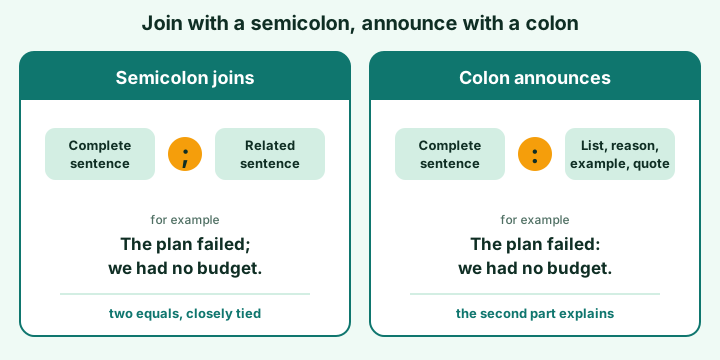
Semicolon vs colon comes down to one question: are you joining two sentences of equal weight, or announcing something? A semicolon joins; a colon points. Once you hear the difference, you will rarely need to look it up, and the punctuation checker will have far less to flag.
Both marks sit between a complete sentence and whatever comes next, which is why they get swapped so often. The trick is to look at what follows. If it is another full sentence about the same subject, you want a semicolon. If it is a list, an explanation, an example or a quotation, you want a colon.
The quick test: join or announce
| Mark | Its job | Before it | After it | Example |
|---|---|---|---|---|
| Semicolon ; | Joins | Complete sentence | Complete, closely related sentence | I trusted the plan; the numbers backed it up. |
| Colon : | Announces | Complete sentence | List, explanation, example or quotation | I trusted one thing: the numbers. |
| Semicolon in a list | Separates big items | Item that contains commas | Next item | Lyon, France; Turin, Italy; and Porto, Portugal |
Run this three-step check on any sentence you are unsure about:
- Cover everything after the mark. Is what is left a complete sentence? If not, neither mark belongs there, with one exception: a semicolon in a complicated list.
- Now cover the part before the mark and read what follows. A full sentence that is a close partner of the first points to a semicolon.
- If what follows is a list, a definition, the reason or the result, it points to a colon.
When to use a semicolon
Between two related independent clauses
Use a semicolon when two sentences are so closely linked that a period would feel too hard a stop, and a comma alone would be a splice. The first draft was long; the second was shorter. The ideas are a pair, and the semicolon keeps them together. It is also the cleanest fix for a comma splice, as explained in how to fix a comma splice.
Before however, therefore and similar words
A word such as however, therefore, moreover, nevertheless or for example that starts the second clause needs a semicolon before it and a comma after it. I wanted to go; however, it rained. A comma alone before however is the commonest hidden splice I see. The details are in the however section of the comma guide.
In a list whose items contain commas
When the items themselves contain commas, plain commas stop working. Compare We visited Lyon, France, Turin, Italy, and Porto, Portugal with We visited Lyon, France; Turin, Italy; and Porto, Portugal. Only the second shows you where one item ends and the next begins. Keep the semicolon before the final and if you use a serial comma elsewhere.
Before a conjunction, rarely
Normally the comma before and or but is enough. A semicolon before a conjunction is for long clauses that already hold commas: The first draft, which I wrote in a hurry, had too many adjectives; but the second, after a long rest, read well. If a sentence needs that much help, I usually split it in two instead.
When to use a colon
A colon says, in effect, here it comes. It follows a complete sentence and introduces what the sentence promised.
- A list. Bring three things: a pen, a photo ID and your ticket.
- An explanation or result. I had one goal: finish before dark.
- A quotation or a formal statement. Her answer was short: “No.”
The most common colon mistake
Do not put a colon between a verb or preposition and its object. The words before a colon must be able to stand as a sentence.
Right: My favorite fruits are apples and pears.
Also right: I have two favorite fruits: apples and pears.
The same applies after such as, including and for example in the middle of a sentence. No colon follows them. A colon is fine after the following and as follows, because those finish a complete clause.
Capital letters after a colon
Styles disagree. Chicago-style lowercases the first word after a colon unless it begins two or more sentences, a direct question or a quotation, while AP-style capitalizes it when a complete sentence follows. I pick the style that matches my publisher and apply it everywhere. A capital after a semicolon is never needed unless the word is a proper name.
Colons that are not part of the sentence rules
Times (10:30), ratios (3:1), a salutation in a business letter (Dear Ms. Chen:) and URLs (https://) all use colons by convention. A good checker leaves those alone.
The same two clauses, three different effects
Take two short clauses and change only the mark between them. The facts do not change, but the signal to the reader does.
| Version | What the reader hears |
|---|---|
| The plan failed. We had no budget. | Two separate facts. The link is left for the reader to work out. |
| The plan failed; we had no budget. | Two linked facts of equal weight. |
| The plan failed: we had no budget. | The second clause is the reason for the first. |
I choose the colon when the second clause answers the question why? or what? raised by the first, and the semicolon when the two clauses are parallel or contrasting. If neither fits, a period is a perfectly good choice.
Common mistakes and the fix
| Wrong | Right | Why |
|---|---|---|
| I stayed home; because it rained. | I stayed home because it rained. | A semicolon needs a full sentence after it, and “because it rained” is not one. |
| You need three things; flour, eggs, milk. | You need three things: flour, eggs, milk. | The second part is a list, so the mark announces. |
| She asked: if I was ready. | She asked if I was ready. | The words before a colon must be a complete sentence. |
| It was late, we left. | It was late; we left. | A comma alone makes a splice. |
| Lyon, France, Turin, Italy, and Porto, Portugal | Lyon, France; Turin, Italy; and Porto, Portugal | Items that contain commas need a stronger separator. |
If you write in French, Spanish or German
The English rules above do not carry over to spacing. French puts a space before both a semicolon and a colon (a thin non-breaking space before the semicolon and a full non-breaking space before the colon in typographers' practice), as the Babbel overview of French spacing explains. Spanish and German put no space before either mark. The checker has a language selector, so it applies the right spacing for the language you choose; in Canadian French it spaces only the colon.
For the dash side of the same family of marks, read em dash vs en dash vs hyphen.
FAQ
Can a semicolon replace a comma splice?
Yes. If both sides of the comma are complete sentences, replacing the comma with a semicolon fixes the splice, provided the two ideas are closely related. A period or a comma plus conjunction also works.
Do I capitalize after a semicolon or a colon?
Not after a semicolon, unless the next word is a proper name. After a colon it depends on the style guide: Chicago-style lowercases unless two or more sentences follow, while AP-style capitalizes a complete sentence.
Can I use a colon after 'such as' or 'including'?
No. Those words continue the sentence, so the list follows directly: 'tools such as a pen and a ruler'. A colon needs a complete sentence before it.
Do I use a semicolon before 'and'?
Rarely. A comma before 'and' is normal for two clauses. Use a semicolon only when the clauses already contain commas and a comma would confuse the reader.
Is a semicolon the same as a period and a comma?
It behaves like a soft period. It ends one clause and starts another without a full stop, so the two clauses must each be able to stand alone.