Em dash vs en dash vs hyphen
Updated October 12, 2026 · 6-minute read · 7 sections
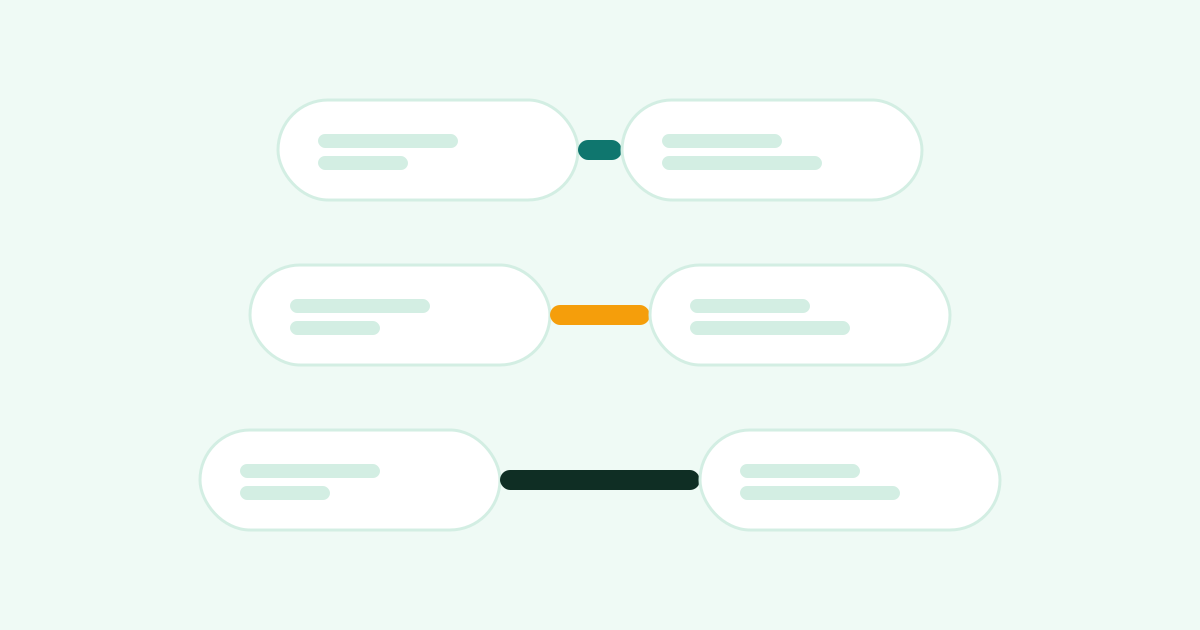
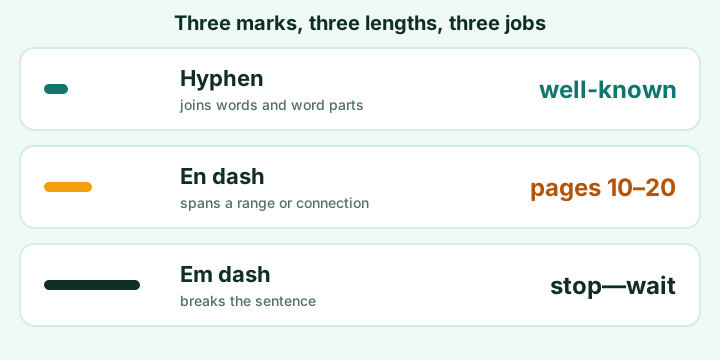
Em dash vs en dash vs hyphen is a question about length, because each mark does a different job. The hyphen joins words, the en dash spans a range, and the em dash breaks a sentence. Mixing them up is among the most common typography slips in otherwise clean text, and the easiest to fix once you know the pattern.
Most people type a single hyphen for all three because it is the only one on the keyboard. That works on screen, but it looks wrong in print and in polished web copy. This guide gives you the rule for each mark, the style differences between US and UK writing, and the keystrokes to produce them. The punctuation checker flags the usual offenders, such as a spaced hyphen used as a dash.
The three marks at a glance
| Mark | Character | Code | Job | Example |
|---|---|---|---|---|
| Hyphen | - | U+002D | Joins words and word parts | a well-known author |
| En dash | – | U+2013 | Spans a range or a connection | pages 10–20 |
| Em dash | — | U+2014 | Breaks or interrupts a sentence | The test—which I hated—was long. |
The names come from print: an em dash was as wide as the letter M, an en dash as wide as the letter N, and a hyphen is shorter again. The Chicago Manual of Style, whose rules most US publishers follow, uses all three and spaces none of them. Its Q&A on hyphens, en dashes and em dashes sets this out.
Hyphen: joining words
A hyphen glues words together so the reader treats them as a single unit. It is the mark with the most small rules, and the checker leaves most of them alone, but three cover nearly every case:
- Compound modifiers before a noun. a well-known author, a 10-year-old child, a full-time job. After the noun, the hyphen usually goes: the author is well known.
- No hyphen after an adverb ending in -ly. a highly paid job, not a highly-paid job. The adverb cannot be mistaken for part of the noun.
- Suspended hyphens. When two compounds share a base word, the first keeps its hyphen: left- and right-hand margins. Chicago allows a space after the hyphen here, and only here.
The big mistake is using a hyphen with spaces around it as a dash: The test - which I hated - was long. That is a hyphen doing an em dash's job. Chicago never calls for spaces around a hyphen, so a spaced hyphen between words is always a flag.
En dash: ranges and connections
Use an en dash for a range of numbers, dates or times, and for a connection between two things. Read it as to, through or between.
- Numbers and pages: pages 10–20, 2–4 hours.
- Days and months: Monday–Friday, May–September.
- Scores and ratios of two sides: a 3–1 win.
- Connections: the London–Paris train.
Two rules keep ranges clean. First, never mix the dash with the words that already express the range: from 10 to 20, not from 10–20, and between 5 and 10, not between 5–10. Second, do not turn identifiers into ranges. A phone number such as 555-0142, a part number or an ID keeps its hyphens. That is why the checker only suggests 10–20 for 10-20 in its Strict mode, where the cost of a false alarm is accepted.
A related character, the true minus sign (U+2212), is for subtraction and negative numbers: −5. It is wider than a hyphen and sits level with the plus sign, but most body text does fine with an ordinary hyphen-minus.
Em dash: interrupting the sentence
An em dash makes a break in the flow of a sentence. It can mark an abrupt change, an emphatic aside or an explanation, and a pair of them can stand in for parentheses or commas. The test: could I swap in a comma or parentheses without changing the sense? If yes, the dash is a matter of tone.
| Version | Effect |
|---|---|
| The test, which I hated, was long. | Neutral. The aside reads as an ordinary part of the sentence. |
| The test (which I hated) was long. | Quieter. The aside is a murmur. |
| The test—which I hated—was long. | Emphatic. The aside is spoken with force. |
My own habit is one pair of em dashes, or one single dash, per paragraph at most. A page full of them reads breathless, and each one loses its force. I also avoid putting an em dash next to a comma, semicolon or colon. If the dash is doing the job, the extra mark is redundant.
Spaced or unspaced? US vs UK style
Here the two traditions part ways. US publishers follow Chicago: all three marks unspaced, so word—word for an em dash. Many UK publishers prefer a spaced en dash in place of the em dash: word – word. Neither is wrong. What matters is that you use one convention throughout.
| Style | Result |
|---|---|
| Wrong (spaced hyphens) | The test - which I hated - was long. |
| US (unspaced em dash) | The test—which I hated—was long. |
| UK (spaced en dash) | The test – which I hated – was long. |
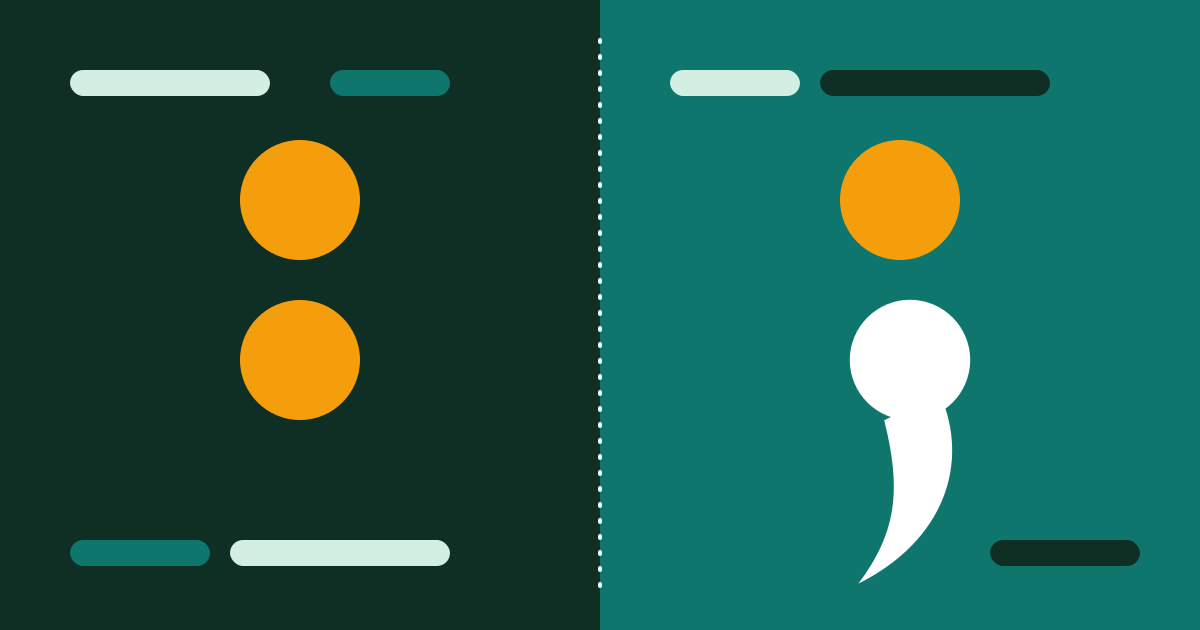
Two hyphens in a row (word--word) are the typewriter way of writing an em dash. Replace them with a real one. The checker's consistency report counts unspaced em dashes, spaced em dashes and spaced en dashes in a document and offers to make them match by majority, and its language setting changes which form a fix suggests: an unspaced em dash for US English, a spaced en dash for UK and AU English.
How to type each mark
| Mark | Mac | Windows | HTML |
|---|---|---|---|
| Hyphen | Hyphen key | Hyphen key | - |
| En dash | Option + hyphen | Alt + 0150 (numeric keypad) | – |
| Em dash | Shift + Option + hyphen | Alt + 0151 (numeric keypad) | — |
Word processors help. In Word, typing two hyphens between words with no spaces and then continuing usually turns them into an em dash by AutoCorrect, and a spaced hyphen between words usually becomes an en dash. That second one catches people out when the US convention is wanted. The easiest approach is to write the text however it comes and clean up with a search at the end.
A five-step dash clean-up
- Search for a space, hyphen, space (
-) and replace each with an em dash (US) or a spaced en dash (UK). - Search for two hyphens and replace them with an em dash.
- Search for a digit, a hyphen, a digit. Turn real ranges into an en dash; leave phone numbers, IDs and codes alone.
- Check from … to and between … and phrases for an en dash that should be words.
- Read once for spacing: all unspaced, or all spaced, never a mix.
The same habit of consistency applies to commas and lists, so see comma rules with examples and semicolon vs colon next. You can also paste a draft into the punctuation checker and let it do steps one and two for you, and step three in Strict mode.
FAQ
Is a hyphen the same as a dash?
No. A hyphen (-) joins words and word parts, such as 'well-known'. A dash is longer and does a different job: the en dash (–) spans ranges and the em dash (—) interrupts a sentence.
Do I put spaces around an em dash?
In US style, no: 'word—word'. Many UK publishers use a spaced en dash instead: 'word – word'. Pick one convention and use it throughout the document.
When do I use an en dash instead of a hyphen?
Use an en dash for ranges and connections, such as 'pages 10–20' or 'the London–Paris train'. Keep hyphens for compound words, phone numbers and IDs.
How do I type an em dash?
On a Mac, press Shift + Option + hyphen. On Windows, hold Alt and type 0151 on the numeric keypad. Word often converts two hyphens between words into an em dash automatically.
How many em dashes are too many?
I limit myself to one pair, or one single dash, per paragraph. If a sentence works with commas or parentheses, the dash is probably a matter of tone, not necessity.