Comma rules with examples (and how to fix a comma splice)
Updated October 12, 2026 · 8-minute read · 7 sections
Comma rules with examples are easiest to learn as a short list of situations, not as one long rulebook. Learn the comma splice first, then the introductory comma, the series, and the places a comma does not belong, and you will fix most of what a punctuation checker flags.
I mark up a lot of text, and the same handful of comma problems turns up on every page. This guide is ordered by how often they cost a reader a stumble, not by how they appear in a grammar book. Each rule comes with a wrong version, a right version and the reason.
Comma splice: how to fix it
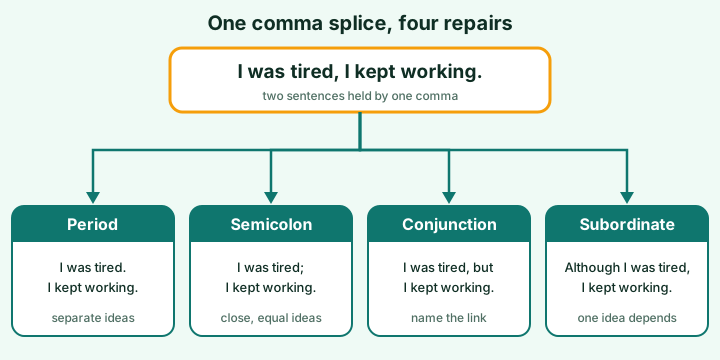
A comma splice happens when a comma is the only thing between two independent clauses, meaning two groups of words that could each stand alone as a sentence. The rule, as the Purdue Online Writing Lab puts it, is that a comma may join two independent clauses only together with one of the seven coordinating conjunctions: for, and, nor, but, or, yet, so (the FANBOYS list). See the Purdue OWL comma rules for the full set.
Right: I was tired, but I kept working.
There are four clean repairs, and the choice is a judgement call about how the two ideas relate:
| Repair | Result | When I choose it |
|---|---|---|
| Period | I was tired. I kept working. | The ideas are separate, or the sentences are already long. |
| Semicolon | I was tired; I kept working. | The ideas are close and of equal weight. See semicolon vs colon. |
| Comma + conjunction | I was tired, but I kept working. | You want to name the relationship: contrast, cause, addition. |
| Subordinate clause | Although I was tired, I kept working. | One idea clearly depends on the other. |
Here is how I spot a splice in a draft:
- Find a comma in the middle of a sentence and read each side on its own. Does each have a subject and a verb and make sense as a sentence? If either side is a fragment, it is not a splice.
- If both stand alone, look at the first word after the comma. If it is one of the seven conjunctions, you are fine.
- If it is not, you have a splice. A pronoun such as it, this, that, they, he, she, we right after the comma is the strongest tell: It was late, we left.
- Choose one of the four repairs in the table.
One caution: a run of very short, parallel clauses (I came, I saw, I conquered) is a deliberate style choice, not an accident. A tool will flag the pattern; you decide whether the rhythm is worth it.
However, therefore, moreover: the splice in disguise
The most common hidden splice uses a word like however as if it were a conjunction. It is not one. It is an adverb, so a bare comma in front of it still leaves two sentences stuck together.
Right: I wanted to go; however, it rained.
Also right: I wanted to go. However, it rained.
The same goes for therefore, moreover, nevertheless and otherwise when they start a second clause: semicolon or period before, comma after. The word behaves differently depending on where it sits:
| Position | Pattern | Example |
|---|---|---|
| Between two clauses | ; however, | The route was short; however, it was steep. |
| Starting a sentence, meaning “but” | However, + clause | However, the shop was closed. |
| Interrupting a clause | , however, | The plan, however, failed. |
| Meaning “no matter how” | no comma after it | However hard you try, it will not open. |
That last row is the one automatic tools tend to get wrong, which is why the checker on this site flags a sentence-initial However only when the next word is a pronoun or a determiner (I, we, you, he, she, it, they, there, the, this, that, our, my, a, an). However hard is left alone.
The comma after an introductory element
Put a comma after an introductory clause, phrase or word that comes before the main clause. Purdue gives the models: While I was eating, the cat scratched at the door. and Well, perhaps he meant no harm. The comma tells the reader where the lead-in ends and the real sentence starts.
The classic proof that it matters: When we finished eating the dog barked. Read once, the dog is on the menu. When we finished eating, the dog barked. fixes it.
| Lead-in | Comma? | Example |
|---|---|---|
| Subordinate clause (when, while, although, if, because) | Always | If you can, send it today. |
| Transition word (therefore, moreover, for example, in fact) | Always | For example, a table helps. |
| Long phrase (about five words or more) | Yes | After the last meeting of the week, we cleaned up. |
| Short phrase (two to four words) | Optional | After lunch we walked. |
My rule for short phrases: skip the comma if the sentence reads cleanly without it, add it if the reader could misread it. Whichever you choose, be consistent within a document.
Series, the Oxford comma and coordinate adjectives
Commas separate three or more items in a series, as in Purdue's model, lower taxes, protect the environment, reduce crime, and end unemployment. The comma before the final and is the Oxford (serial) comma.
My position on the Oxford comma
I keep it. It costs one character and removes a whole class of ambiguity: I thank my parents, Maya and Leo can read as if your parents are called Maya and Leo. I thank my parents, Maya, and Leo cannot. News styles often drop it and many UK houses leave it out unless needed, which is fine. What is not fine is mixing both in one document, and that is exactly what the consistency report in the checker counts for you; its Make consistent button then follows the majority or the Oxford setting you choose (Always or Never).
Coordinate adjectives
Two adjectives that each describe the noun on their own take a comma: a difficult, stubborn child. The test is simple: can you put and between them, or swap their order? A difficult and stubborn child works, so the comma stays. A small wooden box fails both tests (a wooden small box sounds wrong), so there is no comma.
Where not to put a comma
Over-commaing is as common as under-commaing, especially in long sentences where a pause feels like it wants a mark. Purdue lists the places that never take one:
- Between subject and verb. Wrong: The manager of the new store, approved the budget. Right: The manager of the new store approved the budget.
- Between the two verbs of a compound predicate. Wrong: She opened the window, and let the cat out. Right: She opened the window and let the cat out.
- Inside a compound subject. Wrong: Maya, and Leo went home. Right: Maya and Leo went home.
- Usually, before a dependent clause that follows the main clause. Wrong: The cat scratched at the door, while I was eating. Right: The cat scratched at the door while I was eating. A true contrast, as in I like tea, while he prefers coffee, is the exception and takes the comma.
Dates, places and titles
Items that follow a name or a place are set off by commas on both sides. Purdue's example is Birmingham, Alabama, gets its name… The second comma is the one people forget.
- Places: We moved to Austin, Texas, last spring.
- Dates inside a sentence: The meeting on Tuesday, March 3, ran late.
What a punctuation checker can and cannot see
A rule-based checker is reliable for mechanical problems: a space before a comma, a missing space after one, doubled marks, and a sentence-opening Therefore with no comma. It can flag likely problems such as , however followed by one of those same words, and it offers the semicolon repair. Every comma flag carries a Read the rule link that jumps to the matching section of this guide. It cannot tell whether a clause is truly independent or whether a phrase is essential to the meaning, so some splices and some non-essential clauses need a human read. Use the punctuation checker for the first pass and your own eye for the second.
If you saw a flag about a semicolon or a dash, the matching guides are semicolon vs colon and em dash vs en dash vs hyphen.
FAQ
What is a comma splice?
A comma splice is two independent clauses joined by a comma alone, as in 'I was tired, I kept working.' Fix it with a period, a semicolon, a comma plus a coordinating conjunction, or by turning one clause into a subordinate clause.
Do I need a comma after 'however' at the start of a sentence?
Yes, when 'however' means 'but' or 'nevertheless': 'However, the shop was closed.' When it means 'no matter how', as in 'However hard you try', it takes no comma.
Should I use the Oxford comma?
I recommend it, because it prevents ambiguity in lists of names and phrases. Some styles omit it. Choose one approach and use it consistently in the whole document.
Can a comma ever join two full sentences?
Only with a coordinating conjunction (for, and, nor, but, or, yet, so). A short run of parallel clauses such as 'I came, I saw, I conquered' is a deliberate style choice, not a rule you can lean on in ordinary prose.
How do I tell if two adjectives need a comma?
Try putting 'and' between them or swapping their order. If both still sound natural, use a comma: 'a difficult, stubborn child'. If not, leave it out: 'a small wooden box'.